Static policies fragment capacity in heterogeneous edge networks
Dynamic task arrivals, uneven node capacity, and latency-sensitive workloads make centralized or fixed allocation rules inefficient.
Research Poster
A compact poster-style summary of the IEEE paper, designed for portfolio display, review meetings, and conference-style web presentation.
Dynamic task arrivals, uneven node capacity, and latency-sensitive workloads make centralized or fixed allocation rules inefficient.
Each task is broadcast, feasible nodes compute bids, the highest eligible bid wins, and local capacity is updated after assignment.
Simulations were run on Ubuntu 22.04 with an Intel Core i7-12700 CPU and 32 GB RAM, with task demands spanning small, medium, and large classes.
The auction-based strategy reports 98.2% utilization, 100% task placement, 1.8 residual units, and improved fairness over the static baseline.
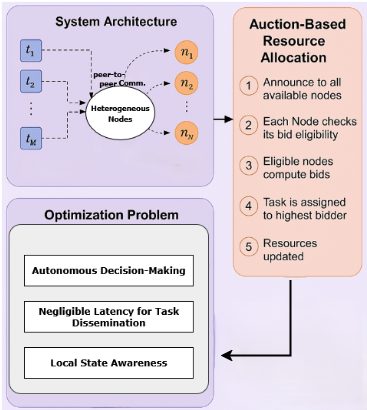
The paper’s original figure condenses the system architecture, optimization framing, and bidding workflow.
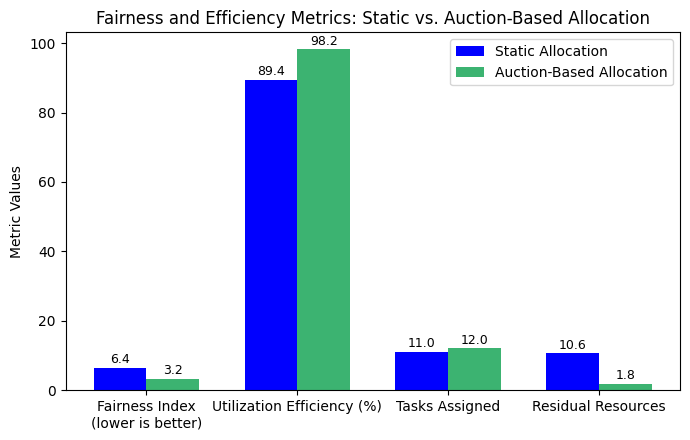
Figure 5 captures the main message: better utilization and fairness with lower residual fragmentation.
Department of Computer and Information Science, Gannon University. This poster now points protected downloads back through the main portal and highlights every major public profile.
Loading citation.