This page converts the conference manuscript into a readable web report. It keeps the full PDF private while still exposing the key ideas, methodology, and evaluation results from the submission.
98% accuracy0.990 ROC-AUC135 ms cross-cloud latency99.6% policy consistency
SIF-CCA extends the original Serverless Intelligent Firewall work into a broader multi-cloud security architecture. The model couples hybrid AI intrusion detection with event-driven mitigation and a unified zero-trust control plane so workloads can be protected consistently across AWS, Azure, and Google Cloud.
The manuscript positions the main research gap as the lack of serverless-native, end-to-end, cross-cloud security systems that combine adaptive AI analytics with quantifiable latency and policy consistency guarantees. SIF-CCA is proposed as a practical answer to that gap.
Research scope and methodology
The paper uses the CIC-IDS2017 dataset and applies a multi-stage preprocessing pipeline: column normalization, duplicate removal, anomaly correction, class consolidation, manual outlier filtering, and balancing by undersampling. This reduces noise and gives the downstream learning pipeline a cleaner feature space.
Data preparation pipeline
Remove duplicate rows and redundant columns.
Replace infinite values and drop rows with missing values.
Consolidate attack labels into broader operational classes.
Standardize numerical features and trim high-impact outliers.
Balance remaining classes for more stable supervised learning.
Model design
XGBoost captures non-linear feature importance and supports fast feature-level learning.
BiGRU models bidirectional temporal relationships in traffic behavior.
A weighted fusion layer balances static and temporal evidence.
Serverless response hooks trigger provider-specific actions after detection.
Design intent: the architecture deliberately separates detection from policy governance so identity, trust, and response can evolve independently as workloads shift across clouds.
System architecture
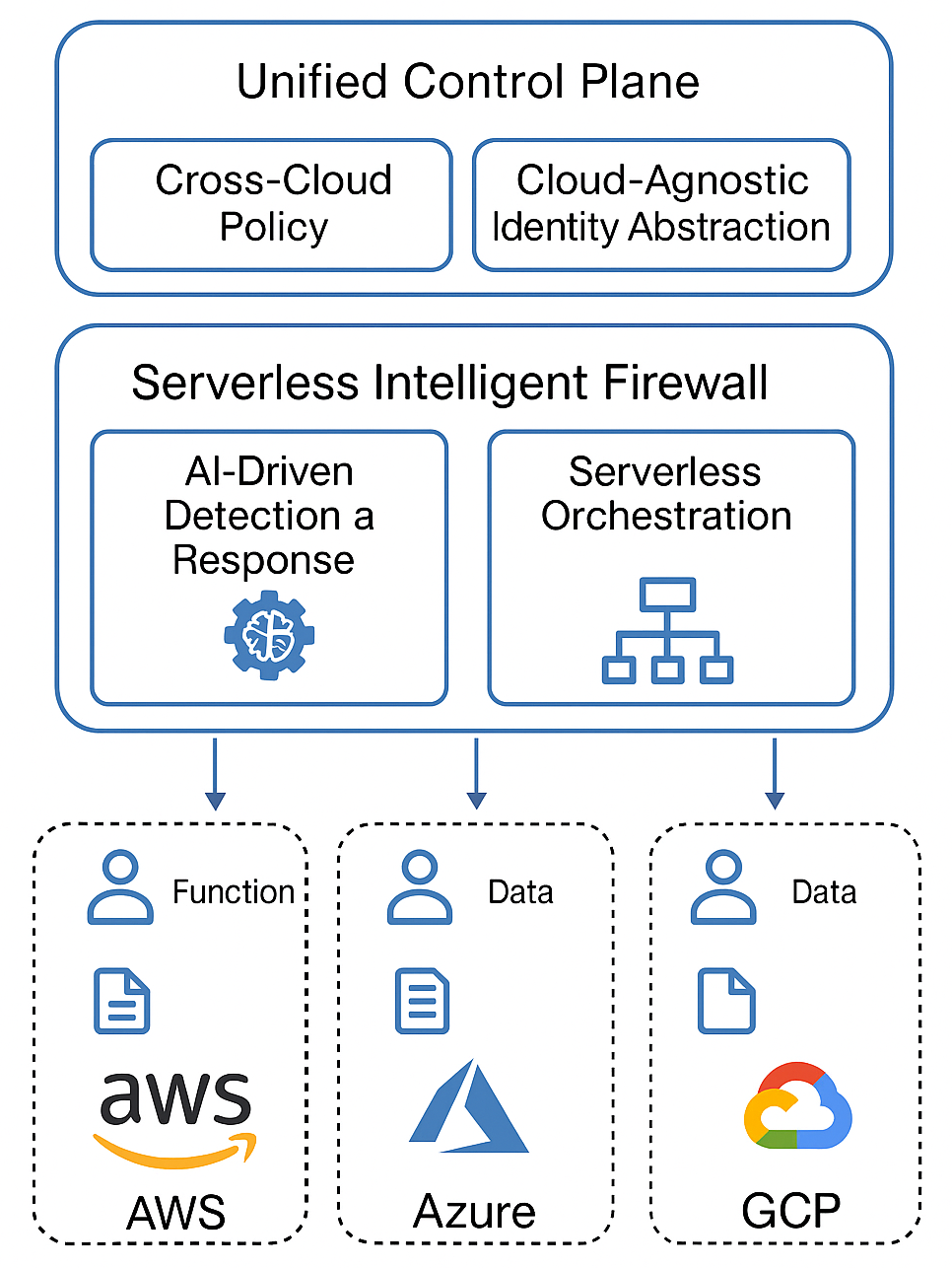
Architecture figure
The manuscript’s main architecture figure shows the detection engine, orchestration layer, and unified control plane spanning AWS, Azure, and GCP.
Operational layers
Detection layer: classifies traffic and scores threats.
Policy layer: enforces zero-trust decisions using cloud-agnostic identity and policy logic.
Provider layer: executes localized actions in each cloud without losing global policy consistency.
Evaluation highlights
The proposed model outperforms the reported baselines on the paper’s primary classification metrics. The web portal retains the exact headline numbers from the manuscript and exposes them as reviewer-friendly tables and charts.
Model comparison
Cross-cloud execution
Accuracy trend line graph
Attack mix pie chart
Policy health radar chart
Performance summary
Metric
Reported value
Accuracy
98.00%
Precision
98.00%
Recall
98.00%
F1-score
98.00%
ROC-AUC
0.990
Zero-trust runtime summary
Measure
Reported value
Policy propagation delay
88.3 ms average
Identity verification latency
111.3 ms average
Policy consistency
99.6%
Cross-cloud avg. latency
135 ms
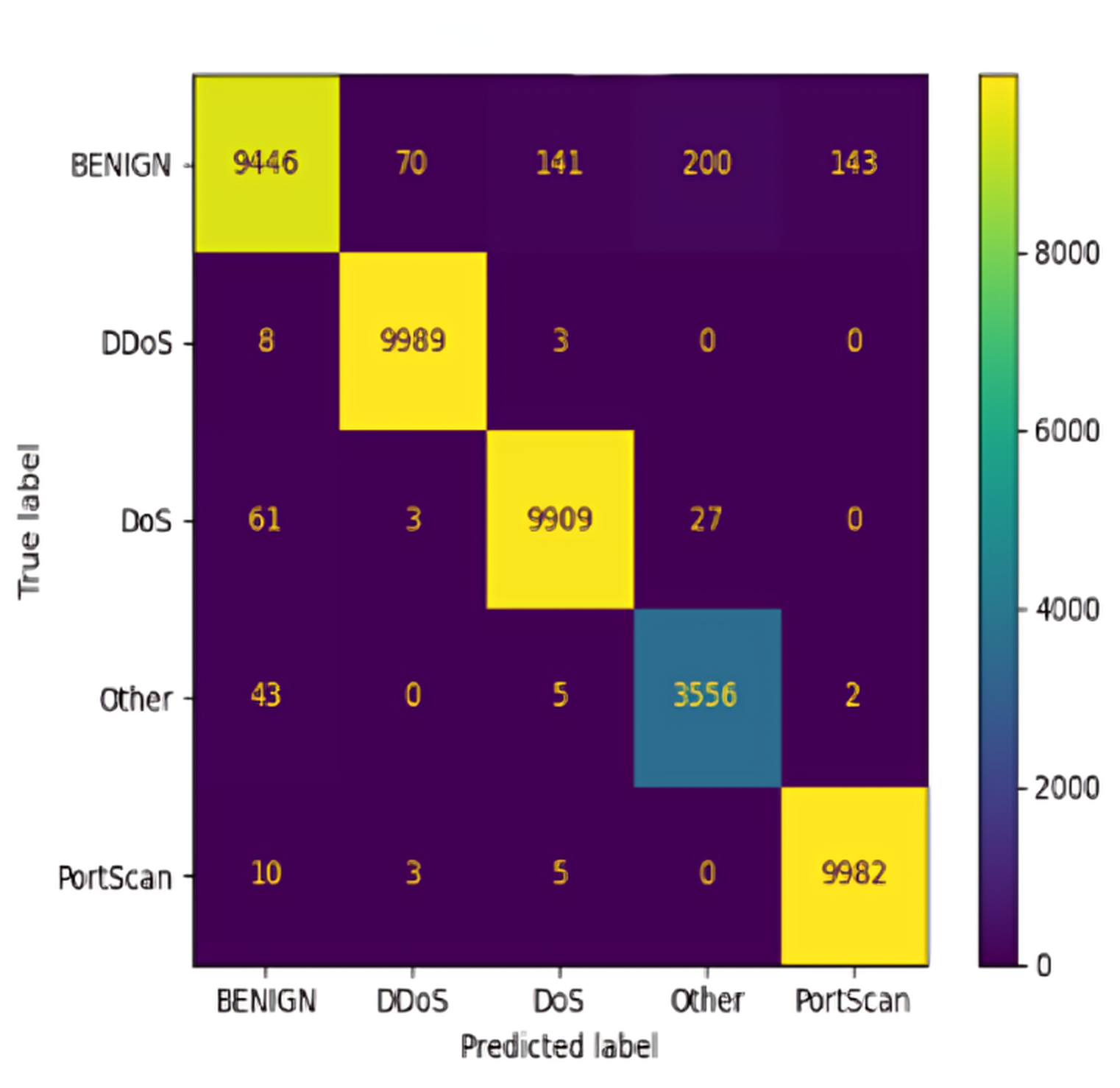
Confusion matrix
High diagonal density indicates strong separation across benign and attack classes.
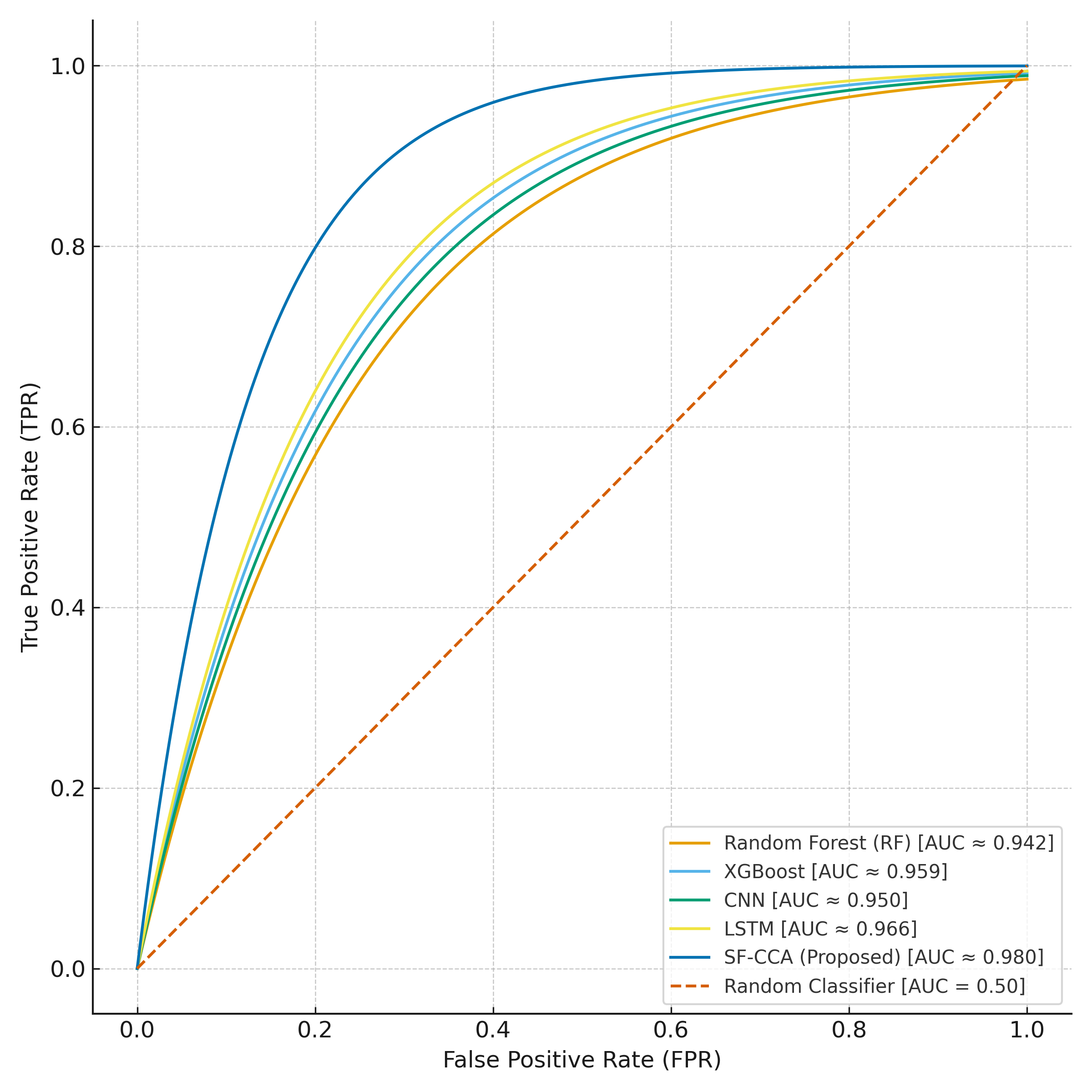
ROC curve
SIF-CCA shows the steepest rise and strongest area under the curve.
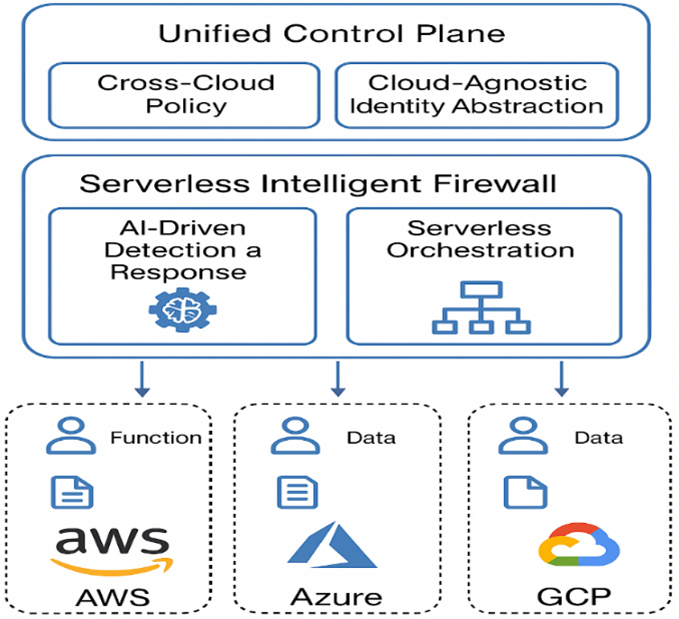
Cross-cloud stance
The control plane normalizes policy and identity posture across providers.
Protected artifact access
Why the files are protected
The full PDF, TeX, and bibliography are intentionally packaged as encrypted archives to keep the submission private while still allowing controlled access for reviewers and collaborators.
The public HTML report remains available so readers can understand the project without direct access to the protected source files.
Access flow
Follow the public GitHub profile.
Review the overview video and subscribe to the YouTube channel.
Email the author to request the password.
Use the secure gate to reveal the encrypted archive links.
Subject: Password request for SIF-CCA research download
Hello Md Anisur Rahman Chowdhury,
I followed the GitHub profile, subscribed to the YouTube channel, and would like the password for the encrypted SIF-CCA research package.
Name:
Institution:
Purpose of use:
Step 3
Enter the password
Enter the password once you receive it from the author.
The password is incorrect. Request the correct password from the author and try again.
Unlocked
Encrypted files ready
These links expose only encrypted zip archives. The password is still required to extract the contents after download.